
Chapter 3
“Your father, then.”
A woman near the register looked uncomfortable. One elderly veteran lowered his newspaper. Nobody intervened. I reached into the ice chest, pulled out a bottle, and placed my money on the counter. I could feel the corporal’s irritation growing because I wasn’t giving him the argument he wanted.
“You’re making a joke out of people who actually served,” he said.
“Please leave me alone.”
Instead, he grabbed my right sleeve. His fingers closed just above my elbow, and before I could move, he pulled the eagle patch from its fastening. The tearing sound was startlingly familiar. He raised it between two fingers like a prize.
“There. Problem solved.”
“Give it back,” I said.
“Buy another one.”
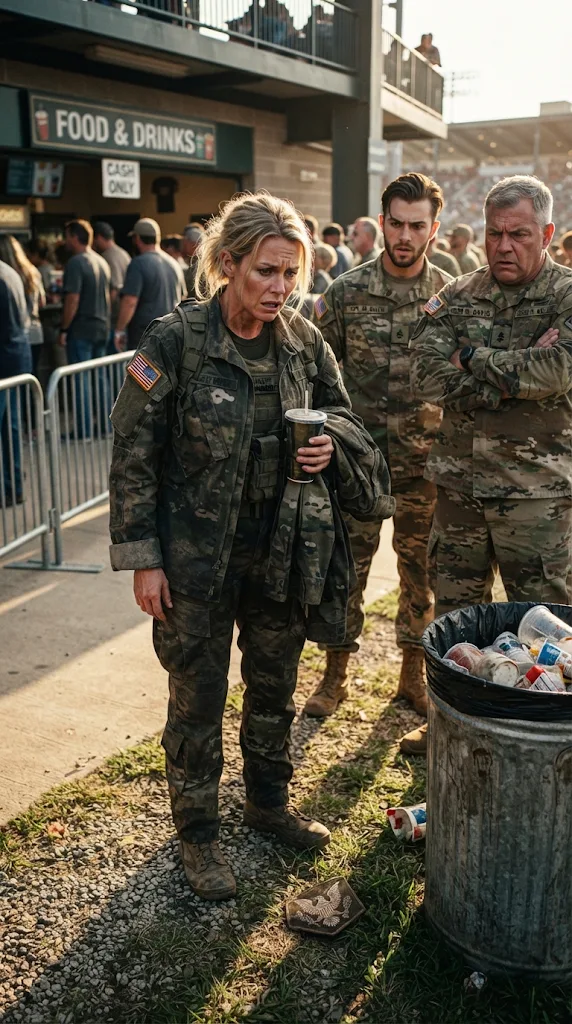
He flicked it toward a trash can. The patch struck the rim and landed face down in the grass.
I stared at it. For fifteen years, that patch had remained attached to my jacket, protecting something I had never found the courage to give away.
“Pick it up, please,” I said.
Rourke folded his arms. “Make me.”
A voice behind him interrupted.
“Corporal. Move.”
A broad-shouldered man in a gray battalion shirt approached the trash can. His tan cap identified no rank, but the corporal immediately straightened. Command Sergeant Major Javier Montoya bent down, retrieved the patch, and brushed away the grass.
Then he turned it over.
His thumb stopped against the narrow strip of faded fabric stitched behind the eagle. He examined the uneven black thread, the shortened edges, and the letters that had nearly disappeared with age.
When he looked at me, his face had gone pale.
“Corporal,” he said quietly, “read the name.”
Rourke leaned forward, suddenly uncertain.
“Calder,” he whispered.
Behind us, the scoreboard carried the same name.
CALDER FIELD.
And the sergeant major was looking at me as though he had finally found someone he had been searching for his entire career.
## Part 2/8
In September 2011, I was twenty-three years old, a sergeant in the United States Army, and the youngest flight medic in our medical evacuation crew. I had joined the Army at eighteen because my family couldn’t afford college and because my mother had spent most of her life working as a nursing assistant in a hospital outside Toledo, Ohio. She came home exhausted, smelling of antiseptic and cafeteria coffee, yet she could remember every patient’s birthday. I wanted a job where remembering someone’s name mattered as much as knowing how to keep them breathing.