
Chapter 2
But it had a roof.
And when you're seventeen with two babies, a roof feels like a miracle.
I attended classes during the day and worked evening shifts at a university library through a special student employment program.
Sometimes I cleaned offices on weekends.
I survived on instant noodles, discounted bread, and whatever groceries I could afford after paying rent.
My daughters, Lily and Rose, were the only reason I kept going.
Every time I thought about giving up, I looked at their tiny faces and reminded myself that they had no one else.
Then came the night that changed everything.
It was November 19, 1998.
Seattle was drowning beneath a cold autumn storm.
Rain hammered against shop windows, filled the gutters, and turned the sidewalks into dark mirrors beneath the streetlights.
I had finished a late shift and was heading home with my daughters bundled close to my chest in a worn double baby carrier.
In my coat pocket was a single ten-dollar bill.
That was all the money I had left.
Ten dollars to last until my next paycheck.
I had already calculated how to spend it.
A little for bus fare.
A little for bread.
And perhaps enough for a few packets of noodles.
I remember standing outside a convenience store, staring at the warm light spilling through the windows.
I was hungry.
So hungry that the smell of fresh coffee made my stomach ache.
But I kept walking.
Then I saw him.
An older man was sitting beneath a rusted metal awning near a closed storefront.
His gray coat was soaked through.
His hands trembled uncontrollably.
His shoes were torn, and water had collected around the soles.
He wasn't holding a cardboard sign.
He wasn't asking anyone for money.
He simply sat there, staring at the pavement while people hurried past.
Some stepped around him.
Others looked away.
Most acted as though he didn't exist.
I knew that feeling.
I knew what it meant to become invisible to people who had once cared about you.
I stopped.
The man slowly lifted his head.
His face was lined with exhaustion, but his eyes were gentle.
For a moment, neither of us spoke.
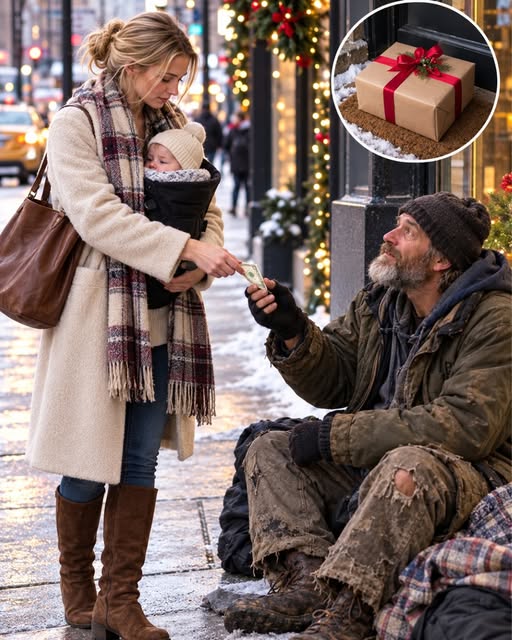
Then I reached into my pocket.
My fingers closed around the ten-dollar bill.
I hesitated.
I thought about my daughters.
I thought about the bread I needed to buy.
I thought about the three days between that night and payday.