
Chapter 9
And whether those movements were intentional or not, they had given him comfort during the hardest weeks of his life.
I kissed the top of his head.
“Thank you for telling me.”
He leaned against my chest.
“Do you believe me now?”
I looked at Emma.
“I believe you've noticed something important. And I want the doctors to help us understand it.”
He seemed satisfied.
Later that morning, I met with Emma's neurologist, Dr. Susan Parker.
She listened carefully as I described what Noah and I had experienced.
I expected her to dismiss it.
Instead, she pulled up a chair.
“Jeremy, I want you to understand something,” she said. “A patient who appears unresponsive can sometimes demonstrate changes that aren't obvious during a brief examination. But we have to distinguish reflex movements from purposeful responses.”
I nodded.
“Can you do that?”
“We can perform repeated assessments and look for consistent responses to specific commands.”
“Could she be conscious?”
“It's possible that her level of awareness has changed. But I don't want to give you false certainty. We need evidence.”
I stared at the floor.
Then I asked the question I had been afraid to ask for two months.
“Is there still hope?”
Dr. Parker paused.
“There is still uncertainty, Jeremy. And uncertainty means we need to keep observing carefully. I can't promise you an outcome.”
It wasn't the answer I wanted.
But it was an answer I could live with.
Over the following days, the medical team began paying closer attention to Emma's responses.
They assessed her movements at different times, used simple commands, and recorded what happened.
Some days, nothing changed.
Other days, there were small movements that could not be clearly interpreted.
I learned how exhausting uncertainty could be.
One morning, I would convince myself she was improving.
By evening, I would be terrified that nothing had changed at all.
But Noah remained remarkably steady.
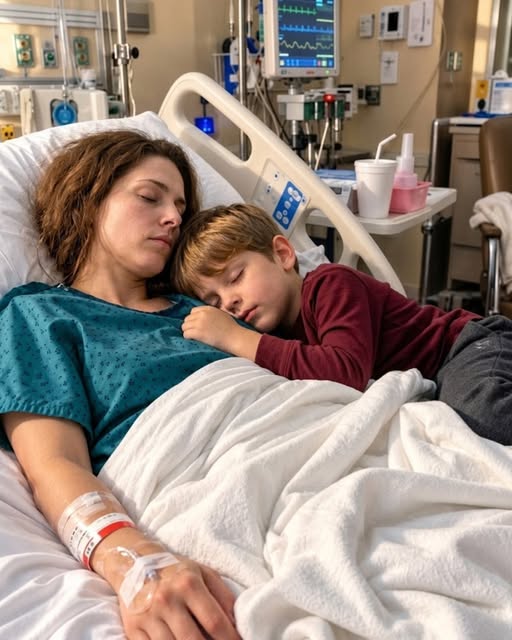
Every afternoon, he arrived with his backpack, washed his hands, and took his usual place beside his mother.
“Hi, Mom. I'm back.”
Then he told her everything.
On Monday, he explained that his class had started a science project about plants.
On Tuesday, he complained that the cafeteria pizza tasted like cardboard.
On Wednesday, he proudly announced that he had scored nine out of ten on a spelling quiz.
Emma didn't respond visibly to any of it.
But Noah kept talking.
And this time, I stayed.